Outreach: the Electron Ejector
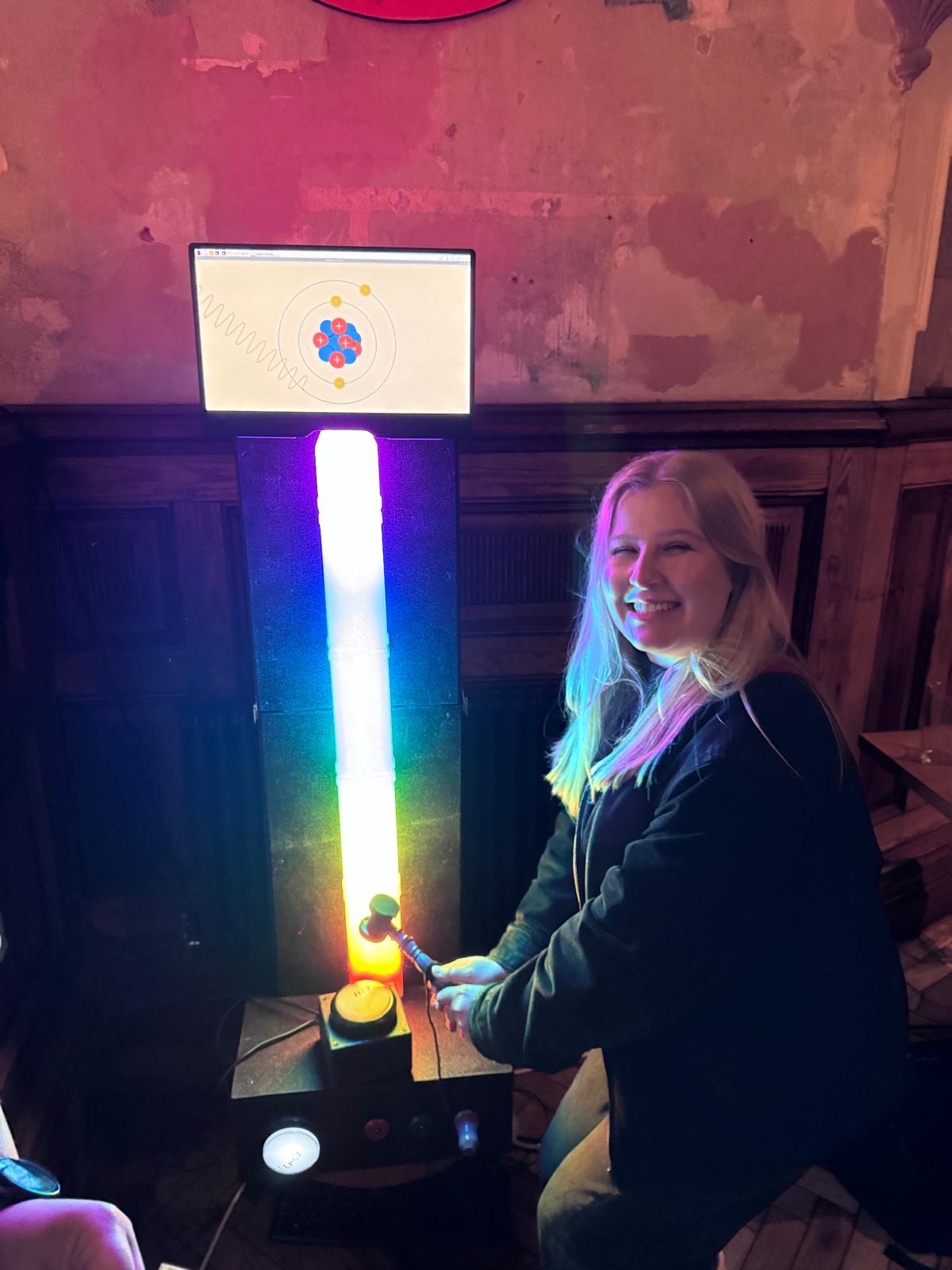
The Electron Ejector looks like a carnival hi-striker, but don't smash it... instead all that counts is the colour of your hammer.
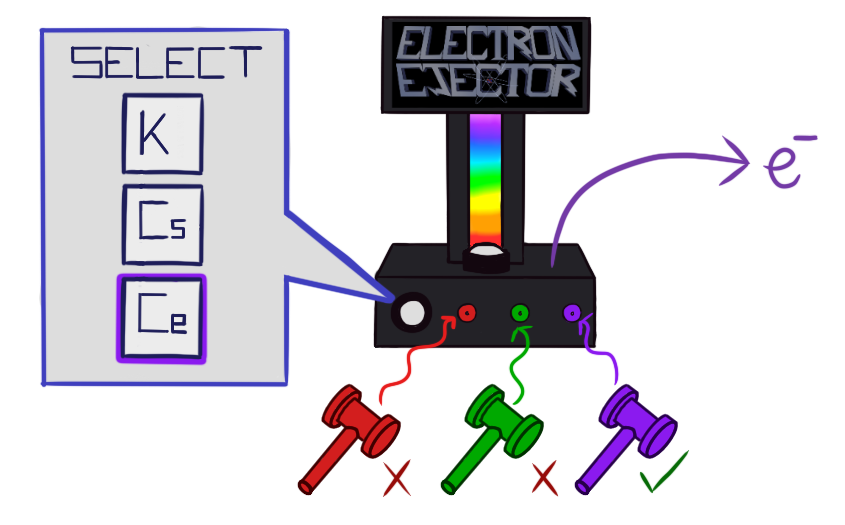
A portable demonstration of the photoelectric effect and wave-particle duality. Players pick a metal, then choose a certain frequency hammer (red, green, or violet light), and see whether it has enough energy to knock an electron free.
We built it to introduce the public to quantum science, and so that A-level students could try out ideas they usually only see on paper. The code, 3D models, and build instructions are all open source, so you can make your own.

Try it
This is a small browser version of the real game, with the same metals, hammers, and screens. Press Select to change metal, plug in a hammer, and press Hit.
Press Select to choose a metal.
The Photoelectric Effect
When light of a specific frequency shines on a metal, electrons are ejected. This is the photoelectric effect, and it was one of the first pieces of evidence for quantum theory. What you'd expect to happen depends on how you think light behaves.
If light is only a wave
Energy flows into the electrons continuously, so any colour of light should eject them eventually and more intense light would just do it faster.
If light comes in packets
Each photon interacts with one electron. Either it has enough energy to free the electron or it doesn't, and energy can't build up from photon to photon.
Below a threshold frequency, which is different for each metal, no electrons come out at all. But light also behaves like a wave: when players look through a prism before picking up a hammer, dispersion spreads white light into a spectrum. We need both descriptions, and quantum theory brings them together.
Modern charactertisation techniques still use this effect today. X-ray photoelectron spectroscopy uses it to probe the composition and electronic structure of materials, and our own research on X-ray spectra also relies on understanding how light and matter interact.
Where it's been
- Imperial Lates: Lights, Colour, Action
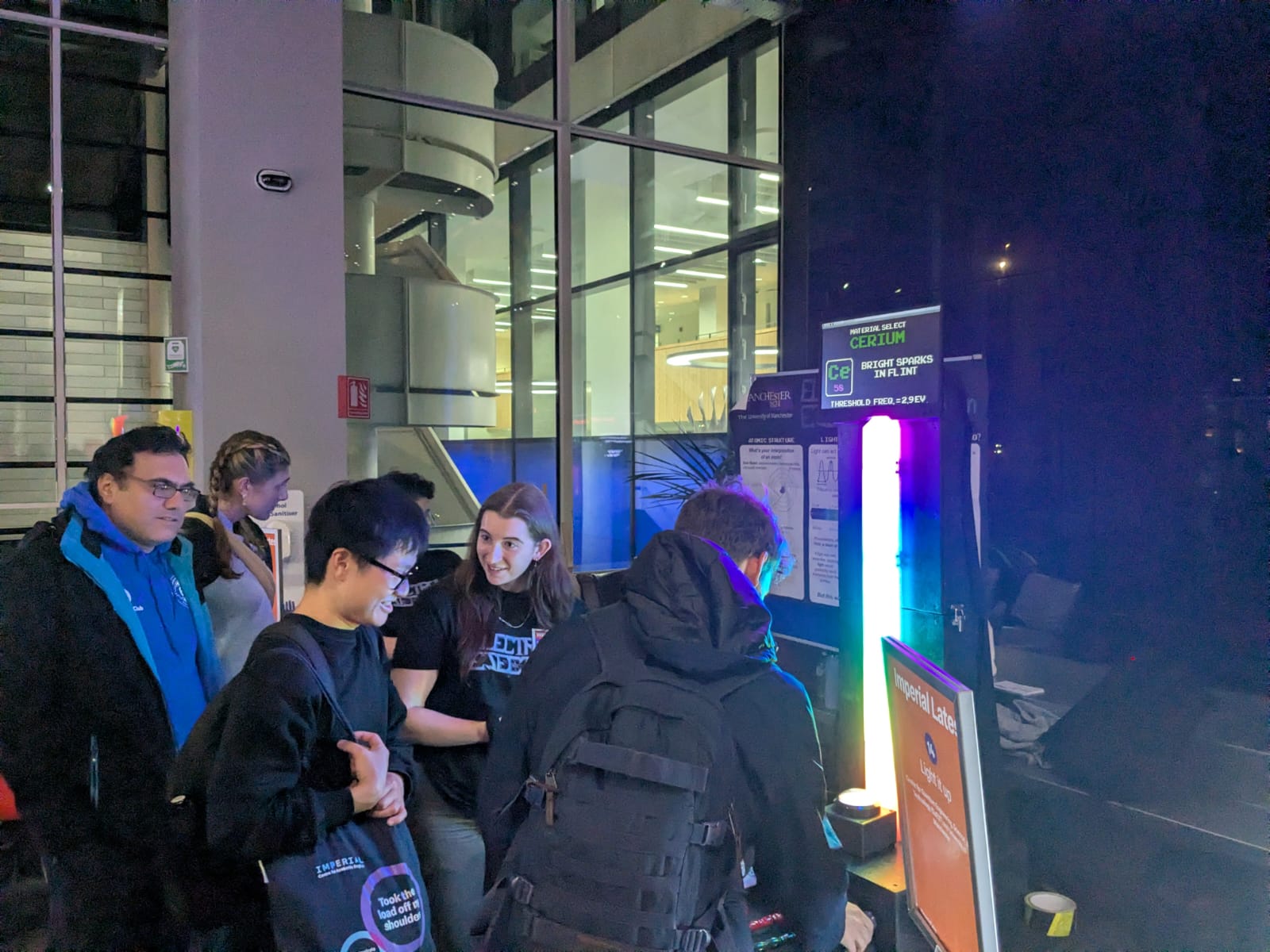
A public event at Imperial College London, with around 700 attendees. - Bolton School
We spent a full lesson with an A-level physics class, using a gold-leaf electroscope, prisms, and the Electron Ejector. Students also looked at the electronics inside the machine and at the Python code. - Pint of Science, Manchester
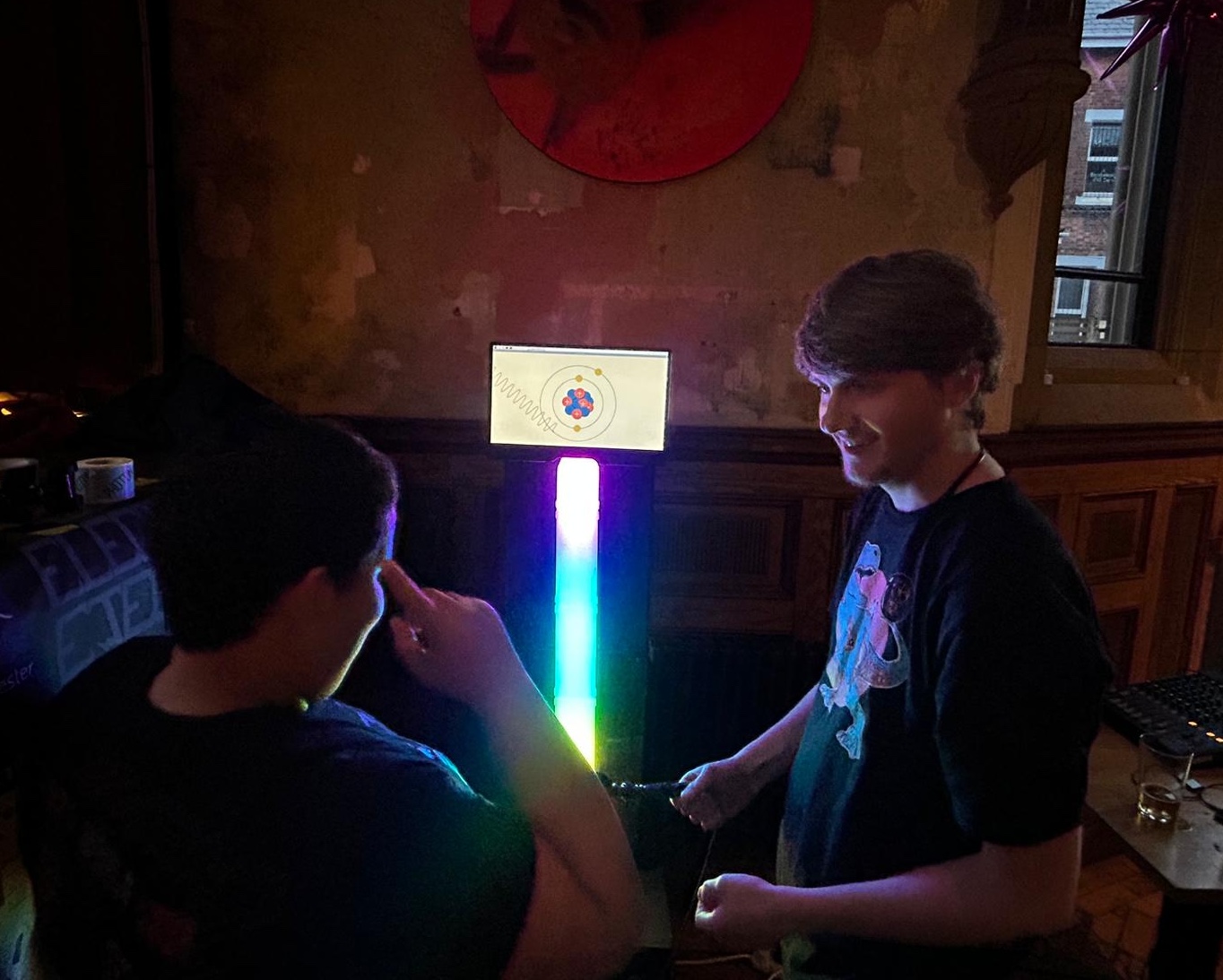
We took it to the Building Next Generation Materials event, which around 50 people attended.
At a public stall, it takes about 10 minutes to go through the whole demonstration with a small group. Everyone gets a photon sticker to take home.
Build your own
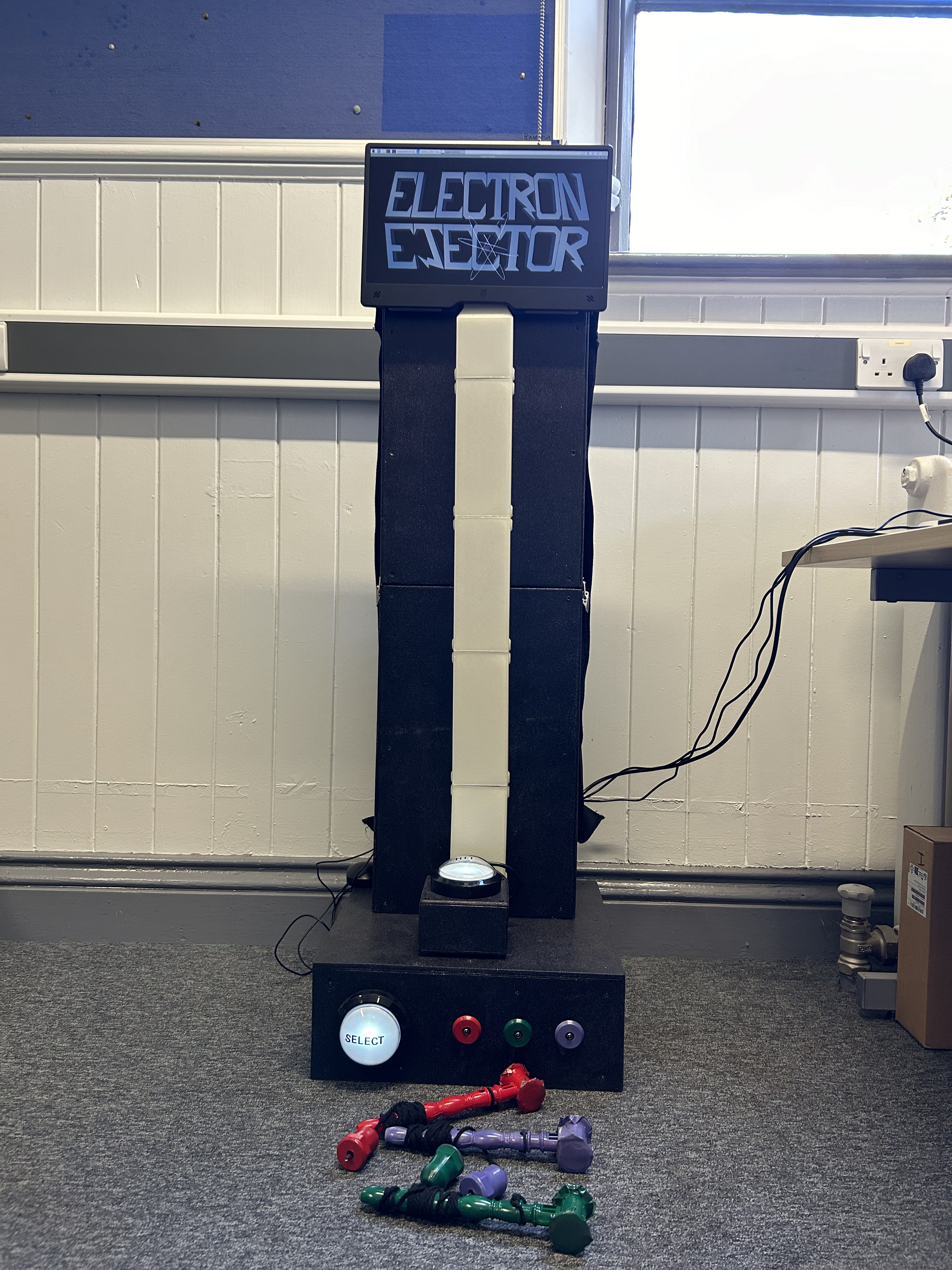
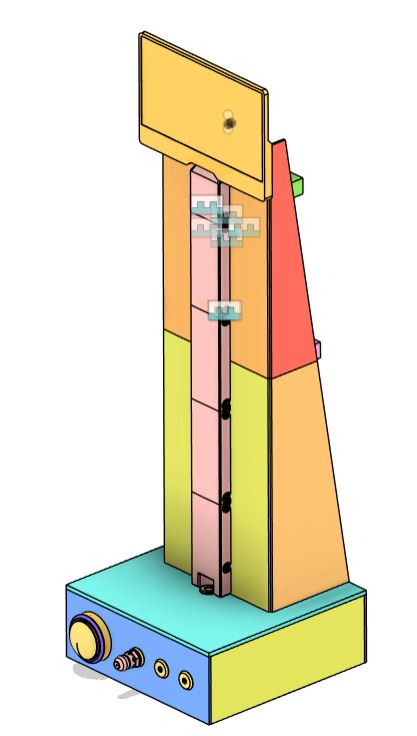
The Electron Ejector is made from low-cost materials and open-source electronics. It folds at a hinge and fits in a suitcase, so it can travel by car or train, and it takes about 30 minutes to put together on site.
- Frame: plywood, timber, and 3D-printed parts
- Computer: a Raspberry Pi 4B running Python
- Display: a 15.6 inch screen and LED strips in a light-diffusing channel
- Controls: Select and Hit arcade buttons, and hammers that plug into barrel jacks
Make your hammers sturdy, as some players really do treat it like a carnival game.
Step-by-step build guide Code and 3D models on GitHub Files at DOI 10.48420/34012971
Acknowledgements
The Electron Ejector was created by Reece Marsden, Samilli Vasconcelos, Toby Thompson, Lana Francis, Aaron Zidichouski (PrintCity, Manchester Metropolitan University), and Meagan Oakley.
It was part of the QChem Project, run by the Imperial Centre for Quantum Engineering, Science and Technology (QuEST) and funded by the Royal Society of Chemistry. With thanks to Dr Kristy Turner, and to Brendan Ickringill and his A-level physics class at Bolton School.